Civil resistance works*

I found this study a while back. I thought it was worth posting. The takeaway for me is this: a movement achieves success with sustained participation. Yes, Dems did well this past election cycle. But nothing was won. In fact the battle is just beginning.
If the economic populist movement which I now claim is to achieve its goals, it must keep its foot on the gas, over years.
Erica Chenoweth, of Harvard’s Kennedy School, after analyzing hundreds of violent and nonviolent movements from 1900–2006 formulated that every nonviolent campaign mobilizing at least about 3.5% of a country’s population at its peak succeeded in achieving its primary goals.
3.5% of registered Dems:
Using the best nationwide estimates, there are about 49–50 million registered Democratic voters in the United States (party registration is tracked by states, not federally, so all numbers are approximations).
Calculation:
- 3.5% of 49 million = 1,715,000
- 3.5% of 50 million = 1,750,000
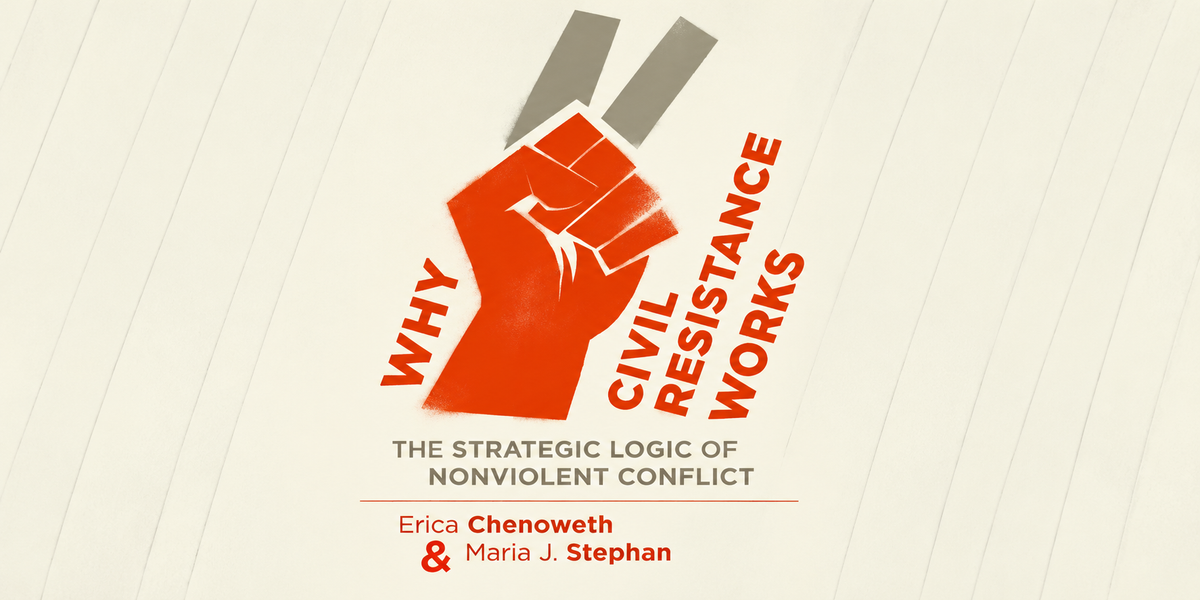
What Chenoweth found - Erica Chenoweth (with Maria J. Stephan) analyzed 323 violent and nonviolent campaigns worldwide from 1900–2006.
- In their book Why Civil Resistance Works (2011), they found that no nonviolent campaign that mobilized at least ~3.5% of a country’s population at its peak failed to achieve its primary objective (e.g., regime change, ending occupation).
- This finding later became widely known as the “3.5% rule.
Key nuances often missed
- Correlation, not a guarantee Chenoweth has repeatedly emphasized that this is an empirical observation, not a law of politics. Mobilizing 3.5% does not mechanically cause success, but historically it has been associated with success.
- Peak participation matters The 3.5% refers to active, sustained participation at peak moments, not passive support or polling approval.
- Nonviolent vs. violent outcomes Across the full dataset:
- Nonviolent campaigns succeeded ~53% of the time
- Violent campaigns succeeded ~26% of the time Nonviolent movements tended to attract broader participation, defectors from security forces, and international legitimacy.
- Primary goals only “Success” means achieving the main stated objective, not necessarily producing long-term democracy or stability afterward.
- Updated research adds caution In later work (post-2010), Chenoweth has noted that:
- Authoritarian regimes have adapted with digital repression, surveillance, and pre-emptive crackdowns.
- Large-scale participation remains powerful, but success rates have declined somewhat in the 2010s compared to earlier decades.
Bottom line
Chenoweth did find that every nonviolent campaign reaching ~3.5% active participation succeeded in the 1900–2006 dataset, but she cautions against treating this as a universal rule or prediction tool.